Why Hampshire Has So Much Clay
If you’ve ever tried to dig in your garden in Southampton, Eastleigh, or Fareham and hit a thick, sticky layer that clings to your spade, you’ve met Hampshire’s clay. The county sits on some of the most extensive clay deposits in southern England, shaped by millions of years of geological history.
Two formations dominate the local geology: the London Clay, which stretches across much of southern Hampshire, and the Reading Beds (also known as the Lambeth Group), which sit beneath it in many areas. Both are classified by the National House Building Council (NHBC) as highly shrinkable clay — and that classification has significant implications for anyone planning to build.
With nearly 20 years of groundworks experience across Hampshire, we’ve worked on hundreds of sites affected by clay soil. Here’s what every homeowner, self-builder, and developer needs to understand before breaking ground.
The Problems Clay Soil Causes
Shrinkage and Heave
The defining characteristic of clay soil is its volume change. When clay dries out — during hot summers or when tree roots extract moisture — it shrinks. When it gets wet again in autumn and winter, it swells. This cycle of shrinkage and heave creates ground movement that can crack foundations, distort walls, and damage structures.
The zone of seasonal moisture change can extend to 1 metre or deeper in open ground, and much deeper where trees are present. This is why Building Control in Hampshire routinely requires foundation depths well beyond the 450mm minimum you might see on stable ground elsewhere.
Poor Drainage
Clay is virtually impermeable. Water doesn’t drain through it — it sits on the surface or runs off. This creates waterlogged sites, standing water in excavations, and challenges for soakaway design. If your project includes a drainage scheme, clay soil means you’ll likely need to explore alternative solutions to standard soakaways, such as attenuation tanks or connection to an existing surface water sewer.
Deeper Foundations Required
On stable, non-shrinkable ground, foundations might only need to be 450mm to 750mm deep. On clay in Hampshire, 1 metre is typically the absolute minimum, and depths of 1.5m to 2.5m are common — particularly where trees are nearby. This directly increases both the excavation work and the volume of concrete required.
How Clay Affects Your Project Costs
Building on clay soil in Hampshire typically costs 20% to 40% more than an equivalent project on stable ground. Here’s where the additional costs come from:
- Deeper foundations: More excavation, more concrete, more time. A foundation trench at 2m deep uses roughly three times the concrete of one at 750mm.
- Specialist drainage: Soakaways often won’t work on clay. Alternative drainage solutions — attenuation systems, pumped systems, or connections to public sewers — add cost and complexity.
- Ground improvement: In some cases, the clay may need to be removed and replaced with engineered fill, or the ground may need stabilisation treatment.
- Structural engineering: More complex ground conditions usually mean you’ll need a structural engineer’s design for the foundations, rather than relying on standard Building Control guidance.
- Longer programme: Deeper excavations, weather sensitivity, and additional Building Control inspections all add time — and time on site costs money.
For a single-storey rear extension on clay soil, you might budget an additional £3,000 to £8,000 for groundworks compared to the same extension on good ground. For a new build, the difference can be tens of thousands.
Solutions for Building on Clay
Deep Trench Fill Foundations
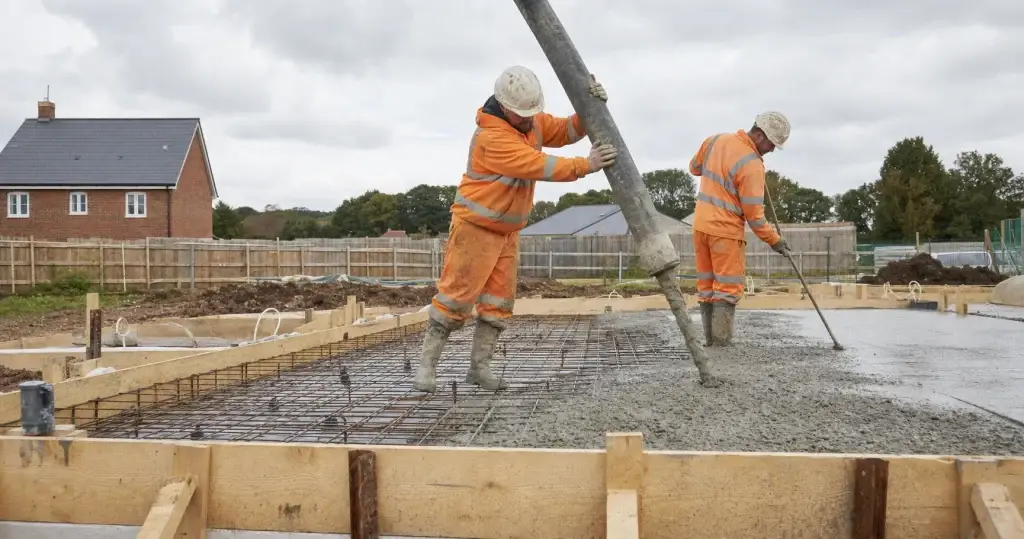
The most common solution in Hampshire is trench fill foundations — trenches dug to the required depth and filled with mass concrete. This is more cost-effective than building masonry substructure walls at depth, and it provides excellent stability. Our team installs trench fill foundations across Hampshire every week — it’s our bread and butter.
Raft Foundations
Where ground conditions are particularly poor or variable, a raft foundation may be specified. This is a reinforced concrete slab that spreads the building’s load across the entire footprint, rather than concentrating it on strip or trench foundations. Raft foundations are more expensive but can be the right solution where the alternative would be extremely deep trenches.
Piled Foundations
For larger structures or very difficult ground, piled foundations transfer loads down through the clay to stable bearing strata below. Piles can be driven or bored, and they’re topped with a reinforced ground beam on which the building sits. Piling is a specialist operation and adds significant cost, but it’s sometimes the only viable option.
Improved Drainage
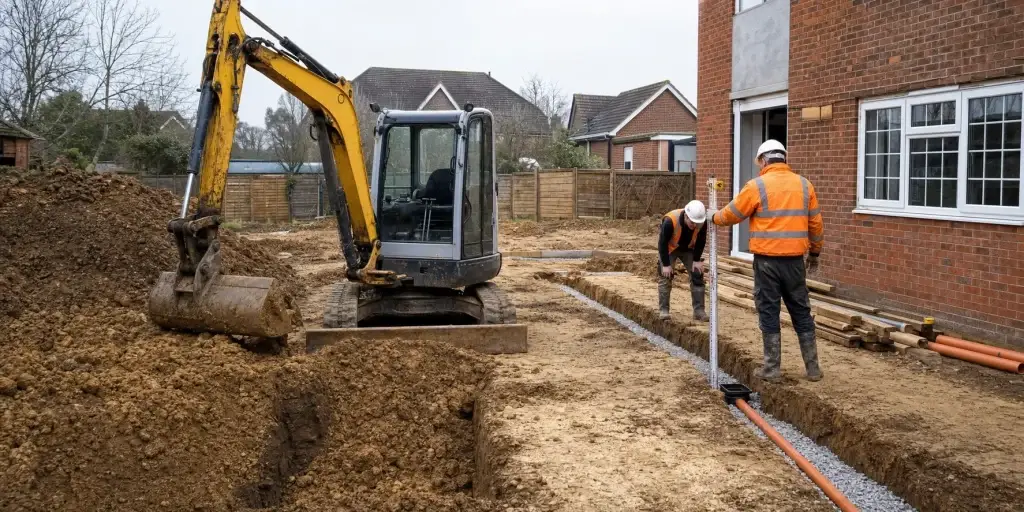
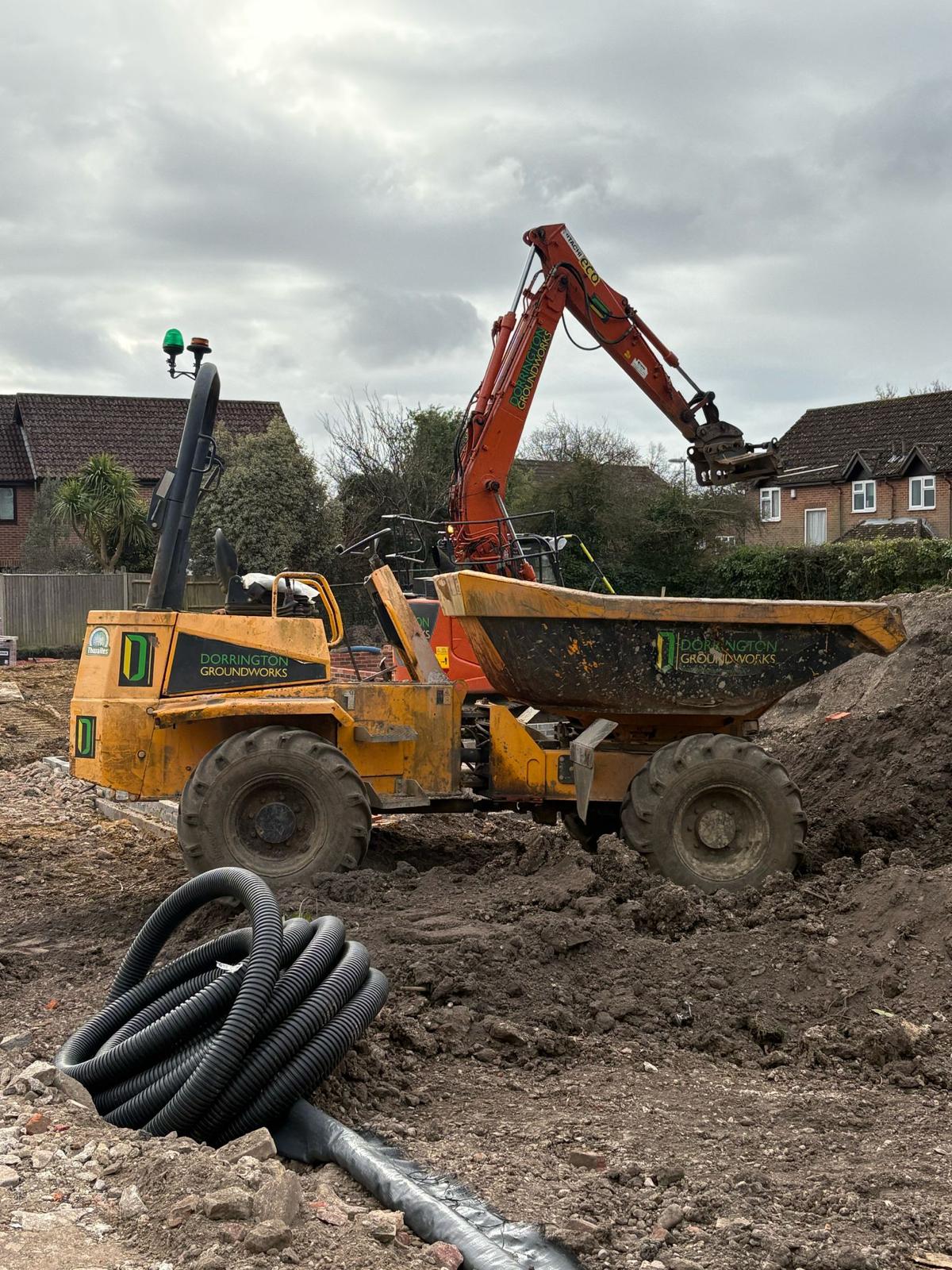
Managing water on a clay site is critical. Solutions include French drains around the perimeter, land drainage to intercept water before it reaches the building, and properly designed drainage systems that account for clay’s impermeability. Good drainage doesn’t just protect the building — it can help reduce ground movement by maintaining more consistent moisture levels.
Ground Improvement and Earthworks
In some cases, the most practical solution is to remove poor clay and replace it with compacted granular fill. This is particularly relevant for earthworks on larger sites where cut-and-fill operations are already part of the programme. We can also stabilise clay using lime or cement, which changes its properties and makes it more suitable as a bearing material.
Tree Proximity and NHBC Guidelines
Trees and clay soil are a particularly troublesome combination. Tree roots extract moisture from clay, causing it to shrink — sometimes dramatically. When a tree is removed, the clay re-hydrates and swells (heave), which can be equally damaging to foundations.
The NHBC publishes detailed guidelines (Chapter 4.2) on minimum foundation depths based on tree species, size, and distance from the building. For example:
- An oak tree (high water demand) within 12 metres of a building on high-shrinkage clay may require foundations at 2.5 metres or deeper
- A willow or poplar can influence ground up to 30 metres away
- Even smaller species like birch or cherry can require depths of 1.5m+ if within 6-8 metres
Building Control in Hampshire takes tree influence very seriously. If there are trees on or near your site, expect the foundation design to account for them — and budget accordingly.
Areas Most Affected in Hampshire
While clay is widespread across Hampshire, some areas are particularly affected:
- Southampton: Much of the city sits on London Clay, particularly the eastern and northern suburbs
- Eastleigh: Extensive clay deposits throughout the borough
- Fareham: London Clay dominates, with some areas of made ground adding further complexity
- Hedge End and Botley: Heavy clay with significant tree cover in many residential areas
- Parts of Winchester: Particularly the lower-lying areas away from the chalk downs
Areas on the South Downs chalk (parts of Winchester, Petersfield) generally have better ground conditions, though chalk presents its own challenges including solution features and variable bearing capacity.
Before You Start: Get a Ground Investigation
The single best investment you can make before building on a Hampshire clay site is a ground investigation. This might be as simple as trial holes dug by your groundworker, or a more formal site investigation with boreholes and laboratory testing. Either way, understanding what’s beneath your site before you design your foundations can prevent costly surprises.
We always recommend that clients establish ground conditions early — ideally before finalising their building design or budget. A foundation that needs to go 2 metres deep instead of 1 metre can add thousands to the cost, and it’s far better to know that upfront.
Talk to Experienced Hampshire Groundworkers
Clay soil doesn’t have to derail your building project — but it does need to be respected and properly dealt with. At Dorrington Groundworks, we’re SMAS accredited and CSCS certified, and we’ve been solving clay soil challenges across Hampshire for nearly 20 years. We know the ground conditions in Southampton, Eastleigh, Fareham, Winchester, and everywhere in between.
Call us on 01489 539197 for a free site visit and no-obligation quote, or contact us online. We’ll assess your site, explain your options, and deliver a foundation solution that’s built to last.