The Short Answer: Probably Not — But It’s Not That Simple
One of the most common questions we hear from homeowners and builders in Hampshire is whether groundworks require planning permission. The short answer is that most groundworks — foundations, drainage, site clearance — don’t need their own planning permission because they form part of a building project that already has approval.
However, the longer answer involves understanding the distinction between planning permission and Building Regulations, knowing the specific situations where additional permissions are required, and being aware of local considerations that can affect projects in Hampshire.
With nearly 20 years of delivering groundworks across Southampton, Winchester, Fareham, and the wider Hampshire area, we’ve navigated these regulatory requirements on hundreds of projects. Here’s a clear, practical guide to help you understand what applies to your situation.
Planning Permission vs Building Regulations: The Key Distinction
These two regulatory systems are separate and serve different purposes, but they’re frequently confused.
Planning Permission
Planning permission controls what you can build, where you can build it, and what it looks like. It’s concerned with the impact of development on the local area — the size of extensions, the appearance of new buildings, effects on neighbours, and the character of the neighbourhood. Planning permission is granted by your local planning authority (Hampshire County Council, Southampton City Council, Winchester City Council, etc.).
Building Regulations
Building Regulations control how things are built — the structural integrity, fire safety, energy efficiency, drainage, and accessibility of construction work. Almost all groundworks fall under Building Regulations because they’re structural and involve drainage. Building Regulations approval is obtained through either the local authority Building Control team or a private Approved Inspector.
The critical point: Even when groundworks don’t need planning permission, they almost always need Building Regulations approval. Skipping this step is illegal and can cause serious problems when you come to sell the property.
When Groundworks DON’T Need Planning Permission
In the majority of residential projects, groundworks are simply the below-ground component of a building project that already has planning permission (or falls under Permitted Development). Specifically:
- Foundations for an approved extension or new build — The planning permission covers the whole project, including the groundworks
- Drainage for a new building or extension — Again, covered by the main planning approval
- Site clearance — Clearing vegetation, removing topsoil, and preparing a site for approved construction doesn’t need separate permission
- Internal drainage repairs or replacements — Maintaining or upgrading your existing drainage system within your property boundary
- Garden landscaping and levelling — Minor earthworks within your garden generally fall under Permitted Development
When You DO Need Planning Permission
There are specific situations where groundworks — or works closely associated with them — require their own planning permission or other formal approvals:
Retaining Walls
If your project involves building a retaining wall that exceeds 1 metre in height adjacent to a highway or public footpath, or 2 metres elsewhere, planning permission is required. This catches many projects on sloping sites where significant cut-and-fill operations create the need for substantial retaining structures.
Drainage Near Public Sewers
If you’re building within 3 metres of a public sewer (or 6 metres for a public rising main), you need a Build Over Agreement from your water company — Southern Water in most of Hampshire. This isn’t planning permission as such, but it’s a formal approval that must be obtained before work begins. Southern Water can take several weeks to process these applications, so apply early.
Work Near Boundaries
If your foundations or excavations will be close to the boundary with a neighbouring property, the Party Wall Act 1996 may apply (more on this below). While not a planning matter, it’s a legal requirement that can affect your programme if not addressed in advance.
Listed Buildings and Conservation Areas
If your property is listed or within a conservation area, the rules change significantly. Any works that affect the character of a listed building — including below-ground works that might disturb archaeological remains — require Listed Building Consent in addition to any planning permission. In conservation areas, Permitted Development rights are often restricted, meaning works that would normally be allowed without permission may need a formal application.
Tree Preservation Orders
If there are trees on your site protected by a Tree Preservation Order (TPO), you cannot carry out groundworks that would damage them — including excavating within their root protection area — without consent from the local authority. In conservation areas, all trees with a trunk diameter above 75mm are automatically protected.
Major Earthworks and Land Raising
Significant changes to ground levels — importing large quantities of fill material, creating raised platforms, or major regrading — may constitute engineering operations that require planning permission in their own right. The threshold is subjective, but if you’re changing levels by more than 300mm over a significant area, it’s worth checking with your local planning authority.
Building Control Inspections for Groundworks
Assuming your project has the necessary planning approval (or falls under Permitted Development), the regulatory process you’ll engage with most during groundworks is Building Control. Key inspection stages include:
- Commencement: You must notify Building Control before starting work on site
- Foundation excavation: Trenches must be inspected before any concrete is poured — Building Control will check the depth, width, and ground conditions
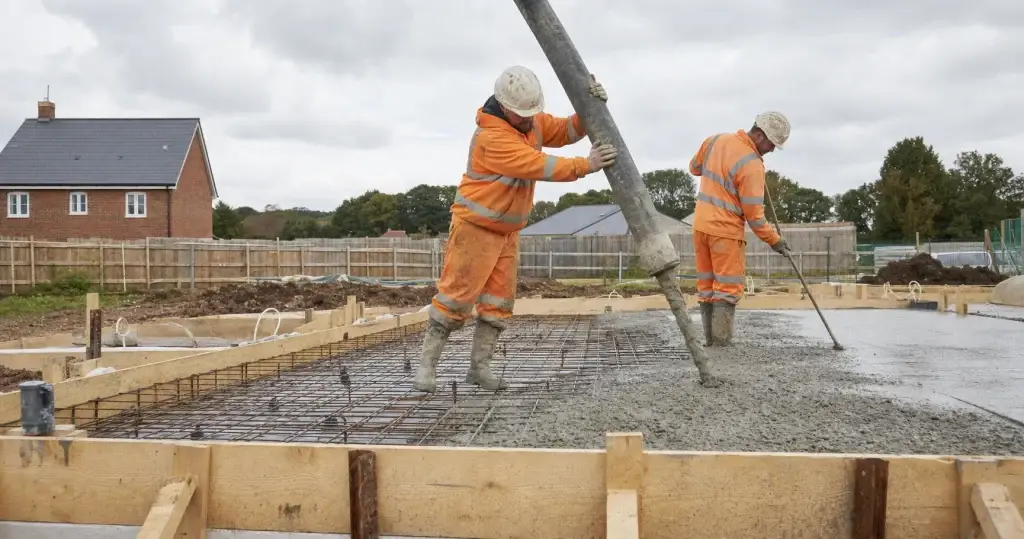
- Foundation concrete: The concrete pour may be inspected, particularly for reinforced foundations
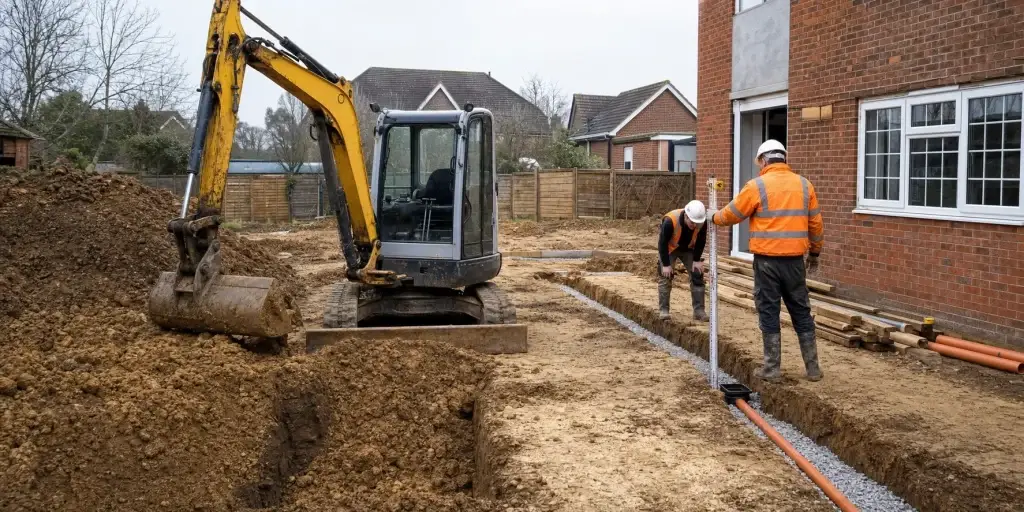
- Drainage: Below-ground drainage must be inspected before backfilling, and an air test or water test is usually required
- Oversite preparation: The ground preparation beneath floor slabs is inspected before the slab is poured
Missing a Building Control inspection can mean digging up completed work — a costly and frustrating outcome. At Dorrington Groundworks, we coordinate all Building Control notifications and inspections as a standard part of our service.
Party Wall Act Considerations
The Party Wall Act 1996 applies when you’re carrying out certain types of work near a boundary with a neighbouring property. For groundworks, the most relevant provision is Section 6, which applies when you’re excavating within:
- 3 metres of a neighbouring building or structure, if your excavation will go deeper than that neighbour’s foundations
- 6 metres of a neighbouring building, if a 45-degree line drawn downward from the bottom of their foundation would intersect your excavation
If the Act applies, you must serve a Party Wall Notice on your neighbour at least one month before starting work. If they don’t consent, a surveyor (or surveyors) must be appointed to prepare a Party Wall Award documenting the work and any protections for the neighbour’s property.
Ignoring the Party Wall Act doesn’t just risk a dispute — it can lead to an injunction stopping your work entirely.
Hampshire-Specific Considerations
Hampshire has several local factors that can affect whether additional permissions are needed for groundworks:
Winchester Conservation Areas
Winchester has extensive conservation areas covering much of the historic city centre and surrounding areas. If your project is within one of these zones, Permitted Development rights may be curtailed, and any external works — including changes to ground levels — may require a planning application.
New Forest National Park
Properties within the New Forest National Park are subject to stricter planning controls. Permitted Development rights are significantly restricted, and even relatively minor works may need planning permission. The National Park Authority is the planning authority for these areas, not the district council.
Flood Zones
Parts of Hampshire, particularly along the River Test, River Itchen, and the coastal areas around Fareham and Gosport, lie within Flood Zones 2 and 3. Groundworks in these areas may need to satisfy additional requirements around flood risk, including a Flood Risk Assessment and specific drainage strategies to avoid increasing flood risk elsewhere.
Archaeological Sensitivity
Hampshire has a rich archaeological heritage. In areas identified as archaeologically sensitive — common around Winchester, Romsey, and other historic settlements — a planning condition may require an archaeological watching brief during excavation. This means an archaeologist must be present to monitor groundworks and record any finds.
How to Check What You Need
Before starting any groundworks project, we recommend the following steps:
- Check your planning permission: Read the conditions carefully — they may specify requirements for foundations, drainage, or ground levels
- Submit a Building Regulations application: Do this before work starts, not after
- Check for public sewers: Request a sewer map from Southern Water to see if any public drains cross your site
- Consider the Party Wall Act: If you’re building near a boundary, take advice early
- Check for TPOs and conservation area status: Your local authority’s planning portal will show these
Let Us Handle the Complexity
Navigating the regulatory requirements for groundworks can be daunting, but it doesn’t have to be. At Dorrington Groundworks, we’re SMAS accredited and CSCS certified, with nearly 20 years of experience managing groundworks projects across Hampshire. We coordinate with Building Control, advise on drainage approvals, and ensure your project meets all regulatory requirements from day one.
Call us on 01489 539197 for a free consultation, or send us a message online. Whether you’re planning an extension in Southampton, a new build near Winchester, or a renovation in Fareham, we’ll make sure the groundworks are done right — and done legally.