Almost every groundworks project produces surplus soil. Dig foundations, a drainage run, a basement, a driveway or a pond, and the material you take out has to go somewhere. On a tight residential plot in Southampton or Winchester, that surplus can quickly become one of the more awkward and expensive parts of the job.
This is where the trade term muck away comes in. It sounds like a small detail on a quote, but soil disposal carries real legal duties, real cost, and real risk if it is handled badly. Get it wrong and you can face delays, a bigger bill than expected, or liability for waste that ends up fly-tipped miles from your site.
At Dorrington Groundworks, we handle excavation, spoil removal and disposal across Southampton, Eastleigh, Fareham, Winchester and the wider Hampshire area. This guide explains what muck away means, why excavated soil is treated as waste, the duty of care that comes with it, what drives the cost, and how to keep that cost under control.
The Short Answer
Muck away is the removal and lawful disposal of surplus excavated material from a site. That includes topsoil, subsoil, clay, hardcore, broken concrete, and mixed arisings from digging.
Once soil is excavated, it is usually classed as waste. That means it has to be handled by a registered waste carrier, taken to a site that is authorised to receive it, and recorded properly. The cost depends on how much material there is, what it is, whether it is contaminated, how easily a lorry can reach it, and how far it has to travel to an authorised facility.
The two biggest levers on price are the type of material and whether any of it can be reused rather than removed. Both are worth getting right before the digger arrives.
What Muck Away Actually Means
Muck away is simply the process of getting dug-out material off site. On a groundworks job it typically covers:
- topsoil stripped during site clearance and enabling works;
- subsoil and clay from foundation trenches and reduced dig;
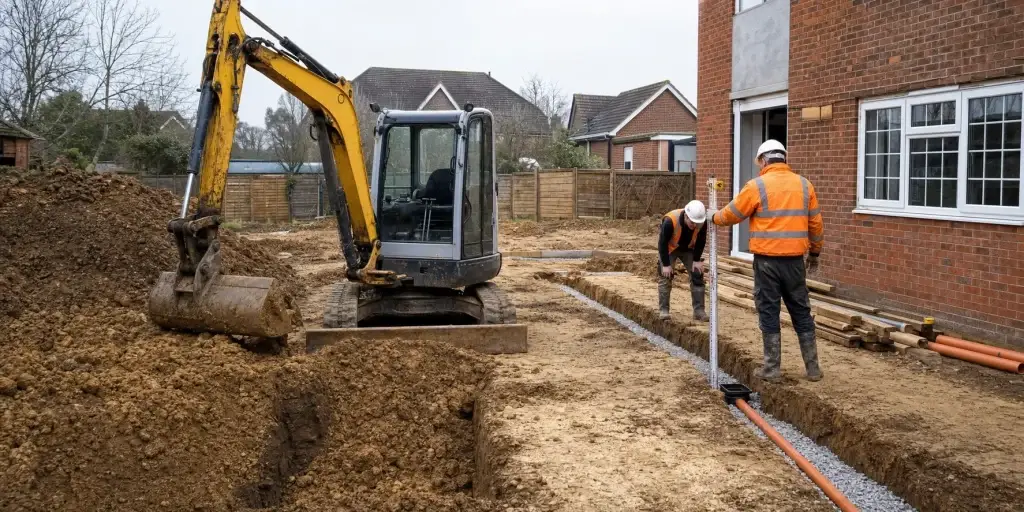
- arisings from drainage runs, soakaways and service trenches;
- spoil from basements, lift pits, ponds and swimming pools;
- old hardcore, broken slabs, kerbs and redundant concrete;
- mixed or made ground found once excavation starts.
It usually goes off site in one of three ways: in skips, in grab lorries, or in tipper lorries loaded by an excavator. The right method depends on volume, access and how clean the material is. We look at those options further down.
Why Excavated Soil Is Treated as Waste
Soil in the ground is not waste. The moment it is dug up and the holder intends to discard it, it generally becomes waste under the Waste Framework Directive and UK waste law. That single point changes everything about how it must be handled.
There is an important exception. Some excavated material can be kept out of the waste system and reused, either on the same site or moved to another, if it is managed under the CL:AIRE Definition of Waste: Development Industry Code of Practice. That code sets out how clean, suitable material can be reused lawfully instead of being sent for disposal. Where it applies, it can cut disposal volumes significantly. Where it does not, the material is waste and the duty of care applies in full.
Your Legal Duty of Care
Anyone who produces or handles waste has a legal duty of care under the Environmental Protection Act 1990. For a homeowner or developer, the key point is uncomfortable but important: your responsibility for the waste does not end when the lorry leaves your gate.
If your soil is passed to someone who is not authorised to take it, and it is later fly-tipped or dumped, you can still be held liable, even though you did not tip it yourself. That is why the paperwork and the carrier check matter.
In practice, meeting the duty of care means:
- using a registered waste carrier to remove material from site;
- checking that the carrier is genuinely registered before they load, using the Environment Agency public register;
- making sure the material goes to a facility that is permitted to accept it;
- keeping a record of the transfer, so the chain can be traced.
The record has traditionally been a waste transfer note. The government is moving to a mandatory digital waste tracking system that replaces paper transfer notes with electronic records, so this side of the job is becoming more formal, not less. A reputable groundworks contractor will handle this as a matter of routine and be able to show you where your material went.
Clean, Inert or Contaminated: Why Classification Matters
Not all spoil is equal. Before material is removed, it should be classified, because that determines where it can go and how much it costs.
In broad terms:
- Inert material, such as clean subsoil, clay, brick and concrete, is the cheapest to dispose of and the easiest to reuse or recycle.
- Non-hazardous material that is not clean inert waste has fewer disposal options and costs more.
- Hazardous or contaminated material, such as soil affected by fuel, asbestos, or historic industrial use, is the most tightly controlled and by far the most expensive to remove.
On brownfield or previously developed sites, a site investigation is often needed to classify the soil and assign the correct waste code. Where material is going to landfill, waste acceptance criteria (WAC) testing may be required to confirm which type of facility can legally receive it. It is the responsibility of whoever produces the waste to classify it correctly before it moves.
This also feeds into Landfill Tax. Standard waste sent to landfill attracts the higher rate of tax, while qualifying inert material attracts a much lower rate. The difference is significant, which is one more reason why keeping clean material separate from contaminated material can save real money.
How Much Muck Will You Actually Remove?
People often underestimate muck away volumes, because they picture the size of the hole rather than the pile that comes out of it.
Excavated soil bulks up once it is dug. Ground that is compacted and settled in place expands when it is loosened, so the loose volume you have to cart away is greater than the neat volume of the excavation. Clay and heavy soils bulk up more than sand and gravel. That is why a trench that looks modest on a drawing can still fill several lorries.
Two other points catch people out:
- Weight, not just volume. Disposal is often priced by the tonne, and wet clay is heavy. A load that fills a lorry by volume may also be at its weight limit.
- Water makes it worse. Saturated spoil is heavier to cart and harder to reuse, so wet weather and high water tables can push muck away costs up.
Getting a realistic estimate of arisings early helps avoid a nasty surprise mid-dig. It also feeds into programme, because lorry movements and tipping have to be planned. Our guide to groundworks costs in Hampshire covers how excavation and disposal sit within a wider quote.
Skips, Grab Lorries or Tipper Muck Away?
The method used to shift spoil affects both cost and how disruptive the job is on a residential street.
Skips
Skips suit small volumes and mixed waste, or sites where a lorry cannot get close to the dig. They are simple, but they are usually the most expensive way to move large amounts of soil, and they fill quickly with heavy material.
Grab lorries
A grab lorry uses a hydraulic arm to load itself from a stockpile, often from the roadside. Grabs are efficient where material can be tipped into a reachable heap, and they reduce the need for a separate loading machine. They do need space and a clear reach to the pile.
Tipper muck away
For larger volumes, an excavator loads tipper lorries directly. This is usually the most efficient option on an active groundworks site with reasonable access, and it keeps pace with the dig. It needs room for lorries to turn or reverse safely and a way to keep the highway clean.
On many jobs the right answer is a combination, matched to access, volume and how clean the material is. Reliable plant and haulage planning keeps the excavation moving rather than stopping every time the spoil heap grows.
What Drives the Cost of Muck Away
There is no single price for muck away, because several factors combine on every site:
- the volume of material, allowing for bulking once it is dug;
- whether it is clean inert, non-hazardous, or contaminated;
- whether any of it can be reused on site rather than removed;
- the weight of the material, especially wet clay;
- access for skips, grab lorries or tippers;
- the distance to an authorised tip or recycling facility;
- tipping charges and Landfill Tax at the receiving site;
- any testing or classification needed before disposal;
- traffic management or road cleaning where lorries use a public road.
This is why a quick per-load figure quoted over the phone can be misleading. A clean dig on an open plot is a very different job from contaminated ground on a tight urban site with a long haul to the nearest suitable facility.
How to Bring Muck Away Costs Down
Disposal is often one of the more controllable costs on a project, if it is planned early rather than reacted to on site. The main levers are:
- Reuse suitable material on site. Clean subsoil can sometimes be used for level changes, landscaping or backfill, cutting the volume removed. Where the CL:AIRE code applies, this can be done lawfully rather than informally.
- Balance cut and fill. Good earthworks planning tries to move material within the site instead of carting it off and then importing fill for something else.
- Keep clean and dirty material separate. Mixing clean inert soil with contaminated or general waste can turn a cheap load into an expensive one and forfeit the lower Landfill Tax rate.
- Screen or recycle where it makes sense. Some material can be screened or crushed and reused, for example broken concrete as hardcore.
- Plan the dig to reduce arisings. Right-sizing foundations and trenches to the design, rather than over-digging, reduces both excavation and disposal.
None of this removes the duty of care, but it can meaningfully reduce how much material becomes waste in the first place.
Common Mistakes That Cost Money
Assuming the hole equals the lorry loads
Bulking means the loose volume is larger than the excavation. Budget for the pile, not the hole.
Using an unregistered carrier to save a few pounds
A cheap, cash, unregistered removal can leave you liable if the material is fly-tipped. Always check the carrier on the Environment Agency register first.
Mixing clean and contaminated material
Once clean inert soil is mixed with contaminated or general waste, the whole load may be charged at the higher rate. Keep materials separate on site.
Leaving disposal until the dig has started
Discovering contamination, made ground or unexpected volumes mid-excavation, with no plan for it, is where delays and extra cost appear. Investigate and plan first.
Ignoring access and the highway
If lorries cannot reach the spoil, or the road is left muddy, the job slows down and can attract complaints or enforcement. Access and road cleaning should be planned, not improvised.
A Practical Sequence Before You Dig
If your project will produce surplus soil, a sensible sequence is:
- Estimate the likely volume of arisings, allowing for bulking.
- Establish what the material is, and whether contamination is likely from the site history.
- On brownfield or suspect ground, arrange a site investigation and any classification or WAC testing needed.
- Decide what can be reused on site, and whether the CL:AIRE code applies.
- Choose the disposal method: skips, grab lorries, tipper muck away, or a mix.
- Confirm your carrier is registered and your receiving facility is authorised.
- Plan access, lorry movements, traffic management and road cleaning.
- Keep transfer records so the chain of custody is documented.
That sequence turns muck away from an afterthought into a planned, priced part of the job.
Where Dorrington Groundworks Fits In
Dorrington Groundworks handles excavation, spoil removal and disposal as part of our wider groundworks packages across Hampshire, West Sussex and Wiltshire. That includes site clearance, foundations, drainage, earthworks and external works, with the muck away planned alongside the dig rather than bolted on at the end.
Because we deal with real sites, real access constraints and real ground conditions every week, we can help you understand the likely arisings, keep clean material separate, reuse what can sensibly be reused, and make sure what does leave site goes through a registered carrier to an authorised facility.
Useful Official Guidance
Requirements change and every site is different, so treat these as starting points rather than a substitute for project-specific advice:
- GOV.UK: business waste and your duty of care
- GOV.UK: Waste Duty of Care Code of Practice
- GOV.UK: register or check a waste carrier
- Environment Agency: public register of waste carriers and brokers
- GOV.UK: how to classify different types of waste
- GOV.UK: Landfill Tax overview
- CL:AIRE: Definition of Waste Development Industry Code of Practice
Planning Excavation and Muck Away in Hampshire?
If your project involves foundations, drainage, site clearance or bulk excavation, Dorrington Groundworks can help you plan the spoil removal and disposal properly, so it does not become the part of the job that causes delays or unexpected cost.
We work across Southampton, Eastleigh, Fareham, Winchester, Portsmouth, Chichester and the surrounding areas across Hampshire, West Sussex and Wiltshire.
Call 01489 539197 or contact Dorrington Groundworks to arrange a site visit and practical advice on your excavation and muck away.
Frequently Asked Questions
What is muck away in groundworks?
Muck away is the removal and lawful disposal of surplus excavated material from a site, including topsoil, subsoil, clay, hardcore and broken concrete. It usually leaves site in skips, grab lorries or tipper lorries.
Is excavated soil classed as waste?
Usually yes. Once soil is dug up and the holder intends to discard it, it is generally classed as waste. Some clean, suitable material can be reused instead of disposed of if it is managed under the CL:AIRE Definition of Waste Code of Practice.
Do I need a licensed carrier to remove soil from my site?
Yes. Waste soil should be removed by a registered waste carrier and taken to an authorised facility. You can check a carrier on the Environment Agency public register, and you should, because your duty of care continues even after the material leaves your site.
Why does contaminated soil cost more to dispose of?
Contaminated or hazardous soil has fewer legal disposal options, often needs testing and classification, and attracts higher tipping and Landfill Tax charges. Keeping clean inert material separate from contaminated material helps avoid paying the higher rate on the whole load.
Can I reuse excavated soil instead of paying for muck away?
Often some of it, yes. Clean subsoil can sometimes be reused for level changes, landscaping or backfill, and good earthworks planning balances cut and fill on site. Where the CL:AIRE code applies, suitable material can be reused lawfully rather than sent for disposal.
Is muck away priced by the tonne or by the load?
It can be either, and often both matter. Disposal is frequently charged by weight, and heavy wet clay can reach a lorry’s weight limit before it fills by volume. The overall price also reflects material type, access, haul distance and tipping charges.
Does Dorrington Groundworks handle muck away and disposal?
Yes. We plan excavation, spoil removal and disposal as part of our groundworks packages across Hampshire, West Sussex and Wiltshire, using registered carriers and authorised facilities, and reusing suitable material on site where we can.