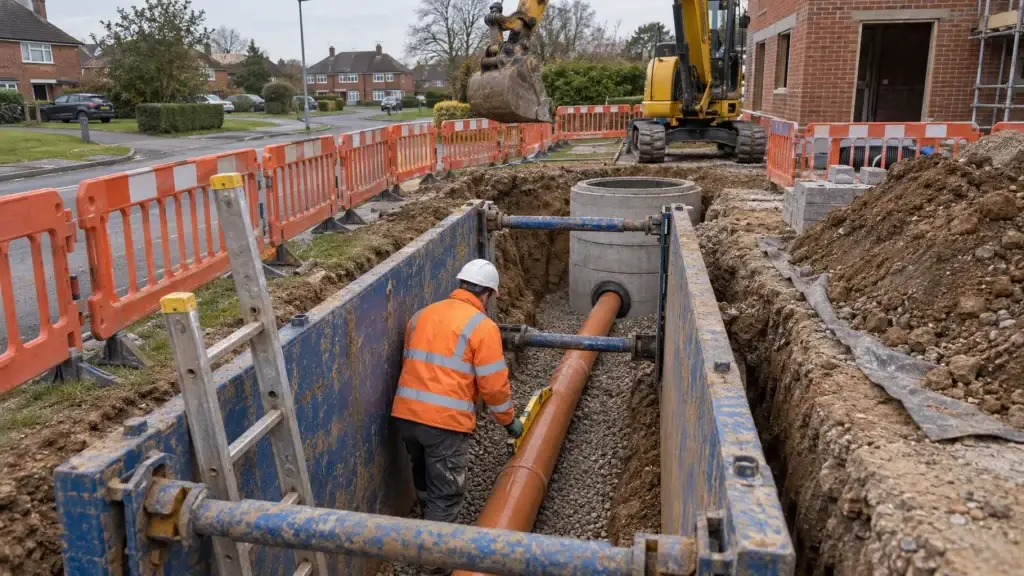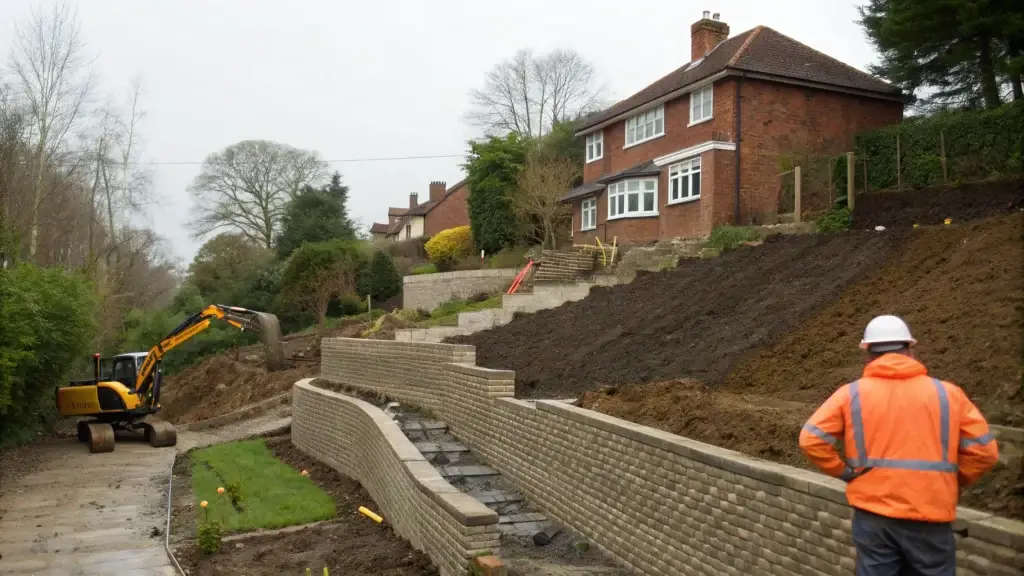
Japanese knotweed on a building plot turns into a programme and waste problem as soon as anyone needs to dig. Foundations, drains and driveways all mean soil being dug and moved, and moving soil with knotweed in it is where most of the legal risk and most of the cost sit.
Dorrington Groundworks carries out site clearance, excavation and muck away for homeowners, builders and developers across Hampshire, West Sussex and Wiltshire. We aren’t knotweed specialists, and a groundworks contractor shouldn’t be the one deciding how knotweed is dealt with. This guide covers where knotweed and groundworks meet: what the law in England says, how far the plant spreads underground, who is responsible for what, the main options before you dig, and what it does to the muck away bill and the programme.
The Short Answer
It isn’t an offence to have Japanese knotweed on your land. It is an offence to cause it to grow in the wild, and moving contaminated soil can count. Soil containing knotweed may be classified as controlled waste, and GOV.UK says it must not be disposed of with other surplus soil.
If you’re going to dig within reach of a stand, get a knotweed specialist to survey it and write a management plan before the groundworks are priced. Herbicide alone isn’t recommended where the ground will be dug, because rhizome deep in the ground can stay dormant but alive for years after treatment, and digging can bring it back or spread it.
The usual routes are digging it out and taking it to a suitably permitted landfill, burying it on the same site under strict conditions, or treating it in a part of the site that won’t be built on. Each needs planning before the first bucket goes in. Finding it halfway through a dig is the expensive case.
What the Law Says in England
The GOV.UK guidance on Japanese knotweed (last updated February 2026) sets out the position. “You do not legally have to remove Japanese knotweed from your land unless it’s causing a nuisance, but you can be prosecuted for causing it to spread into the wild.” It also says you must stop knotweed on your land from spreading off your property.
The offence comes from section 14 of the Wildlife and Countryside Act 1981. Anyone who “plants or otherwise causes to grow in the wild” any plant included in Part II of Schedule 9 commits an offence, and Japanese knotweed is on that list. GOV.UK’s guidance on invasive plants says this “can include moving contaminated soil or plant cuttings”.
Two other routes can catch an owner who does nothing. Councils and the police can issue a community protection notice where someone’s conduct, which the Act says includes failing to act, has a detrimental effect “of a persistent or continuing nature” on the quality of life of people in the area and is unreasonable. A written warning has to come first. And a neighbour worried about it spreading onto their land can take legal action through the courts.
Hampshire councils’ own pages match the GOV.UK position. Portsmouth City Council says “It’s not an offence to have Japanese Knotweed on your land”. Basingstoke and Deane says it can’t take measures to control knotweed on private land.
GOV.UK’s update notes for the page say the Environment Agency isn’t responsible for dealing with knotweed, though you can ask it for guidance. It’s the landowner’s responsibility.
How to Recognise It
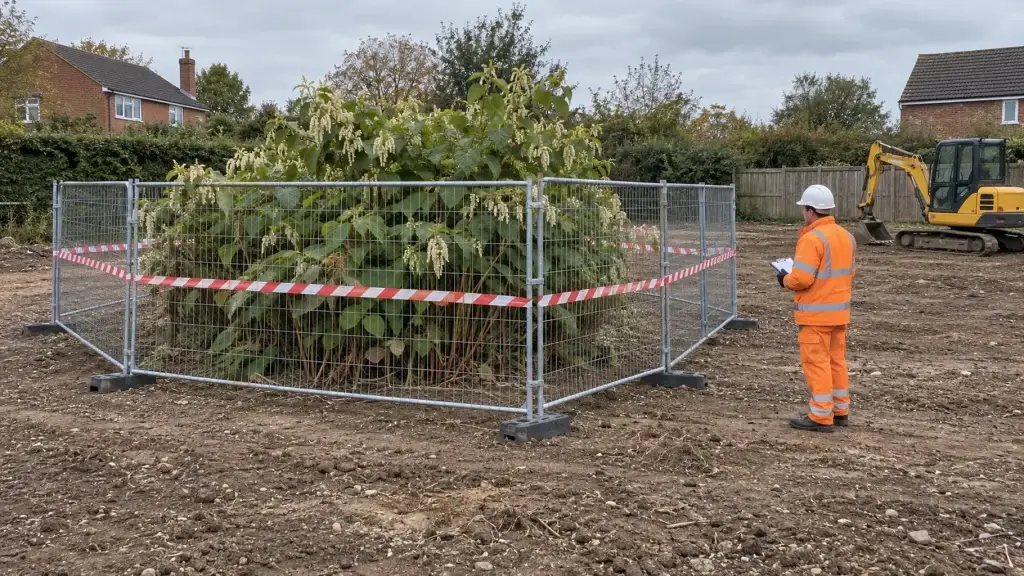
The Hampshire and Isle of Wight Wildlife Trust describes it as “a very tall plant with large triangular leaves, hollow, red stems that are a bit like bamboo, and small, white, tufty flowers that appear in late summer and autumn”. The trust gives its height as up to 2 metres, though Basingstoke and Deane says some stems are over 3 metres high by July. It’s found on riverbanks, waste ground and roadside verges. In winter the stems die back, and you may only see stands of dry brown canes.
Plenty of plants get mistaken for it, and plenty of knotweed gets missed on overgrown plots. If you aren’t sure, get a specialist to confirm it before anything is cut, cleared or dug.
How Far It Spreads Underground
The visible stand is only part of it. The plant spreads through underground stems called rhizomes, and GOV.UK says a new plant can grow from a piece of rhizome as small as 1cm. Rhizome can stay dormant in the soil for years and grow again when it’s disturbed or the soil is moved.
The Property Care Association’s code of practice (November 2023) says rhizome typically extends 2 to 3 metres from the visible plant, to a depth of about 1.5 metres, and that it can go further. The common rule of thumb of 7 metres out and 3 metres down isn’t based on sound statistics, the code says, but it’s still used as a safe distance for biosecurity on site.
For a building plot, that means a stand by the boundary can reach the line of a foundation trench or drainage run several metres away, and a stand next door can be close enough to matter too.
Why It Matters More When You’re Building
On a plot that’s going to be dug, the slow, cheap option of spraying and waiting often doesn’t fit. The PCA code says herbicide treatment alone shouldn’t be recommended on sites where the soil will be dug and disturbed, and that construction works can’t continue in areas that still contain the plant. GOV.UK says treatment usually takes at least three years.
Guarantees are affected too. The PCA’s guidance says that because disturbing the ground makes regrowth much more likely, herbicide treatment guarantees in practice rule out development work or landscaping in the affected area. If a plot comes with an existing treatment plan and guarantee, check what it allows before you design anything over it.
Mortgages are the other reason to deal with it properly. The RICS professional standard on Japanese knotweed and residential property, in force since March 2022, replaced the old 7 metre test with an assessment based on damage and the effect on amenity space. Knotweed on neighbouring land is reported to a lender if a mortgage valuer sees it within 3 metres of the boundary. Where knotweed is causing damage or restricting the use of amenity space, it expects most lenders to require a specialist management plan with an insurance-backed guarantee. If you’re building to sell, buyers’ surveyors will ask what happened to any knotweed on the plot, and you’ll want the paperwork.
Who Is Responsible for What
- The landowner or developer is responsible for the knotweed, for stopping it spreading, and for the waste it produces. They appoint the specialist and pay for the work.
- The knotweed specialist surveys the extent of the infestation, writes the management plan, decides the method, supervises the work around the plant and issues any guarantee. GOV.UK names the Property Care Association and the Invasive Non-Native Specialists Association as the trade bodies many specialists belong to.
- The designer or engineer takes account of the plan in the layout, and designs anything structural such as foundations near a burial cell or root barrier.
- The groundworks contractor excavates to the specialist’s plan and the engineer’s design, keeps knotweed soil separate, controls the movement of plant and vehicles, and loads it for removal by a registered waste carrier or places it where the plan says.
- The Environment Agency regulates the waste side. It must be told where knotweed waste has been sent and given notice before knotweed is buried on site, and it sets the conditions for burial.
- The local authority can issue community protection notices (so can the police) and deals with planning. A neighbour’s claim about knotweed spreading onto their land goes through the courts.
The Main Options Before You Dig
The specialist will recommend a method for the site. These are the options you’re likely to hear about, and what each means for the groundworks.
Treat it and keep away from it
If the stand is in a part of the plot that won’t be built on or dug, herbicide treatment with an exclusion zone around it can work. It takes years, and nothing can be built or landscaped in that area while it’s going on. It rarely suits the footprint of a new building or its drainage.
Dig it out and take it off site
Often called dig and dump. It’s quick, and it clears the area for building, but it’s often one of the more expensive routes. The PCA code describes landfill as a last resort. GOV.UK says you must use a registered waste carrier and a landfill or incineration site with the correct permit, cover or enclose the load, and tell the Environment Agency where you’ve sent it. You must not dispose of knotweed with other surplus soil or sell contaminated soil as topsoil.
The receiving site may want the soil tested first. The PCA code gives a guidance turnaround of about two weeks for laboratory results, longer at busy times, and says the waste could be classed as hazardous depending on the herbicide previously used. Our guide to muck away and soil disposal explains how classification drives the price.
Bury it on the same site
GOV.UK allows knotweed to be buried on the site it came from, at least 5 metres deep, or at least 2 metres deep if it’s sealed in a geotextile membrane that is undamaged, UV resistant and able to stay intact for 50 years. The Environment Agency’s regulatory position statement RPS 178 adds conditions: you need a management plan, the burial must be on land of low habitat value in an area likely to stay undisturbed, more than 7 metres from a neighbouring landowner’s site, and you must keep records for two years. Material can’t be stored for more than 12 months before it’s treated or buried.
The two documents disagree on notice. GOV.UK’s guidance says to tell the Environment Agency at least one month before you bury, and RPS 178 says at least one week. Allow the longer period, or check with the Environment Agency.
On a small plot, finding room for a burial cell more than 7 metres from neighbouring land, in ground unlikely to be disturbed again, is often the problem.
Screen the soil and reuse it on site
Sieving or screening soil reduces the amount of rhizome in it. RPS 178 says it’s unlikely to remove all of it, and that screened soil can only be reused on the same site, in a restricted area, and not within 50 metres of watercourses, ditches or protected areas; on boundaries with neighbouring properties; on existing gardens, lawns and amenity areas; or anywhere that may be used by people or livestock. On a house plot that rules out most of the site.
Root barriers
A vertical root barrier membrane can protect a structure or a boundary from regrowth. The PCA code says it should go no less than 1.5 metres deep and that on its own a vertical membrane isn’t a solution: it must be combined with herbicide treatment and monitoring.
On Site: Keeping It Contained
Most of the ways knotweed spreads on a building site come down to machines and spoil. The practical measures are simple, but they have to be planned in from the start.
- Fence an exclusion zone. The PCA code describes a restricted zone covering the infested ground plus a buffer for how far the rhizome could have spread.
- Keep plant off it. The code says heavy plant shouldn’t drive over areas that may be infested unless a PCA approved specialist is supervising and precautions are taken, and that tracked machines are more likely to spread rhizome than wheeled ones. On a tight plot that affects where the excavator and dumpers can run.
- Keep knotweed spoil separate. Once it’s mixed with clean muck away, the whole pile has a problem.
- Clean machines and vehicles. GOV.UK says vehicles that have carried knotweed waste must be brushed down vigorously or jet-washed and inspected for trapped pieces of plant or rhizome.
- Don’t treat or clear it yourself first. GOV.UK says not to treat knotweed yourself unless you have the skills and experience. Cutting, pulling or digging it before the survey can spread fragments and make the extent harder to map.
What It Does to Cost and Programme
Nobody can give a fair price for knotweed work without the specialist’s survey and plan. What drives it is predictable, though.
The biggest factor is volume. Rhizome spreads beyond what you can see, so the excavation is much bigger than the stand. As an illustration only, a stand 3 metres across, dug out to 3 metres beyond its edge on every side, is a 9 by 9 metre area. At 1.5 metres deep that’s about 120 cubic metres in the ground, and more once it’s dug, because excavated soil bulks up. The specialist sets the actual extent and depth.
Then there’s the testing, the haulage distance to a site that will accept it, landfill charges and tax, the specialist’s fees and any guarantee, and the extra time for segregation and cleaning down. Our groundworks cost guide covers general excavation and disposal prices for comparison.
On the programme, allow for the survey, the plan, soil testing and lab turnaround, and any Environment Agency notice before you book the groundworks. On a plot where the plan is to dig it out, that’s usually weeks rather than days. Where treatment is the plan, it’s years, and the build has to be designed around it.
If You Find It Halfway Through a Job
This is the worst time to find it, and it does happen, especially on overgrown plots cleared in winter. If you think you’ve found knotweed during excavation:
- Stop work in that area and keep machines off it.
- Fence it off and don’t move any soil already dug from around it.
- Don’t let any of that spoil leave site with the normal muck away.
- Get a specialist to confirm it and map the extent.
- Agree the method, then re-plan the dig and the waste routes around it.
The rest of the site can often carry on while this is sorted out, as long as the work stays well clear of the zone.
A Practical Sequence for a Building Plot
- Walk the plot and the boundaries before you buy or design, ideally in the growing season. Check next door too.
- If there’s any sign of knotweed, get a specialist survey and management plan.
- Give the plan to your designer so the layout, foundations and drainage take account of it.
- Price the method, the waste and the time into the build before you commit to a start date.
- Brief the groundworks contractor on the exclusion zone, haul routes, segregation and cleaning down.
- Keep every record: the plan, waste transfer documents, the specialist’s sign-off and any guarantee. You’ll need them when the house is sold or mortgaged.
Where Dorrington Groundworks Fits In
We carry out site clearance, excavation and earthworks, foundations and muck away across Hampshire, West Sussex and Wiltshire, with our own excavators, dumpers and haulage vehicles. Our guide to what’s included in site clearance explains how the first stage of a job usually runs.
Where knotweed is on a plot, that work is done to the specialist’s management plan and the engineer’s design. The survey, the choice of method and any guarantee come from the knotweed specialist, and we don’t replace them, the Environment Agency or your council.
If you’ve seen something on a plot that looks like knotweed, mention it when you ask for a quote so the clearance and muck away can be planned around it. Get in touch or call 01489 539197 to talk it through.
Useful Official Guidance
- GOV.UK: how to stop Japanese knotweed from spreading
- Environment Agency: RPS 178, treatment and disposal of invasive non-native plants
- Wildlife and Countryside Act 1981, section 14
- RICS: Japanese knotweed and residential property
- Property Care Association: code of practice for managing Japanese knotweed (PDF) (industry guidance)
Frequently Asked Questions
Can you build on land with Japanese knotweed?
Yes, but not until it has been dealt with in the area you’re building on. The Property Care Association’s code says construction can’t continue in areas that still contain the plant, and herbicide alone isn’t recommended where the ground will be dug. Get a specialist survey and management plan before the groundworks are designed and priced.
Is it illegal to have Japanese knotweed on your land?
No. GOV.UK says you don’t legally have to remove it unless it’s causing a nuisance. It is an offence under section 14 of the Wildlife and Countryside Act 1981 to cause it to grow in the wild, which can include moving contaminated soil, and you must stop it spreading off your property.
Can knotweed soil go in a normal muck away lorry?
Not mixed with your other surplus soil. GOV.UK says knotweed waste must not be disposed of with other surplus soil. It has to go with a registered waste carrier to a landfill or incineration site with the correct permit, in a covered or enclosed load, and you must tell the Environment Agency where it went.
How deep do you have to bury Japanese knotweed?
At least 5 metres if it isn’t sealed, or at least 2 metres if it’s sealed in a suitable geotextile membrane, on the site it came from. RPS 178 adds conditions including a management plan, a location more than 7 metres from a neighbouring landowner’s site, and notifying the Environment Agency before you bury it.
How far do Japanese knotweed roots spread?
The Property Care Association’s code says rhizome typically extends 2 to 3 metres from the visible plant, to about 1.5 metres deep, and that it can go further. GOV.UK says a new plant can grow from a piece as small as 1cm.
Does Dorrington Groundworks remove Japanese knotweed?
We carry out site clearance, excavation and muck away across Hampshire, West Sussex and Wiltshire. Where knotweed is involved, that work follows a management plan from a knotweed specialist, who surveys the plant, sets the method and issues any guarantee.