If a new house, an extension with a new bathroom or kitchen, or a conversion is going to drain into the public sewer, the water company has to approve the connection before anyone breaks into that pipe. In most of Hampshire that means a Section 106 application to Southern Water.
It is a small line on the programme and an easy one to forget. The application fee is modest. The trouble starts when the drains are laid, the trench is open and the inspection can’t be booked because nobody applied, or when the plan assumed rainwater could go into the foul sewer and the water company says no.
Dorrington Groundworks lays drainage and sewer connections across Hampshire, West Sussex and Wiltshire. This guide covers when you need approval, how the process works, what it costs in 2026/27, who does the physical work, and the points that most often hold a job up.
The Short Answer
You have a legal right to connect your drains to the public sewer, but you must give the sewerage company notice first. Section 106 of the Water Industry Act 1991 gives an owner or occupier the right to have their drains “communicate with the public sewer”, and the company can refuse within 21 days if the way the drain is built doesn’t meet its standards or would harm its network.
With Southern Water you apply online, pay a fee per connection (£299 plus VAT for a connection to an existing sewer or manhole in 2026/27), wait for approval, have your own contractor build the drain and make the connection, then book an inspection before backfilling.
New homes also attract an infrastructure charge, £771 per property for wastewater in 2026/27. Surface water is treated differently: Southern Water will not accept it into foul-only sewers, and you have to show that soakaways and watercourses have been ruled out before a sewer is even considered.
Connecting in breach of Section 106, or before the 21-day period ends, is a criminal offence.
When You Need a Section 106 Application
Southern Water’s sewer connection page says you will need to apply if you are:
- building a new property, or an extension with a kitchen or bathroom
- changing the use of a property, for example commercial to residential
- splitting a site into more properties
- connecting foul drainage that used to go to a septic tank or cesspit
- adding flow through a private sewer that ends up in the public sewer
- increasing the hard surface area of the plot so more surface water runs off
The connection does not have to be directly onto the public pipe. Southern Water’s technical guidance says a connection made indirectly, through a private drain that flows into the public sewer, needs an application too.
When you don’t need one
Southern Water says you will not need to apply if you are connecting to your own private sewer, there is no additional flow, and you are not splitting the property into more units. That work still needs to be done by a competent contractor and signed off by Building Control.
Repairing your own drain on the same line, with nothing new draining into it, is not a new connection.
Planning comes first
Where planning permission is needed, get it before you apply. Southern Water asks for a copy of the planning decision so it can check the drainage strategy and any conditions, and its guidance states that “S106 approval cannot be granted without planning consent.”
Which Water Company Is Yours?
Most of Hampshire and West Sussex is served by Southern Water for sewerage, and this guide uses its process and charges. That isn’t true everywhere we work.
- Wessex Water serves “most of Wiltshire and parts of Gloucestershire and Hampshire”, which matters around Salisbury and the western edge of the county.
- Parts of north Hampshire, including the Basingstoke area, are served by Thames Water for sewerage.
The legal right under Section 106 is the same whichever company it is. Thames Water, for example, also expects the applicant’s own contractor to make most connections and publishes its own consent fees. Check the company for your address before you budget or apply, and use that company’s forms and charges.
How the Southern Water Process Works
Southern Water’s wastewater connections technical guidance sets out five steps:
- You apply online and pay the application fee.
- Southern Water reviews it and sends an approval.
- Your contractor carries out the work.
- You book a site inspection.
- Southern Water sends a completion letter, after which you can start discharging to the sewer.
The approval is for how the connection will be built. It does not confirm there is spare capacity in the sewer. For larger developments or commercial sites, Southern Water suggests a pre-planning enquiry first, which it describes as optional but helpful for larger developments, especially 10 or more properties.
What goes in the application
- a site location plan
- a drainage layout showing foul and surface water drainage up to the connection point
- a copy of the planning decision, where planning applies
- percolation test results if surface water is involved
- for sewers five metres or more deep, or 300mm or more in diameter, your contractor’s health and safety policy and a site-specific risk assessment and method statement
Approval lasts two years. Southern Water says you will need to apply again if it expires, or if you change the applicant or the contractor doing the work. That second point catches people out when a builder changes partway through a project.
Inspection before backfilling
Southern Water asks for at least two working days’ notice before you backfill, so it can inspect the connection. The trench should stay open until the inspection has passed, with signing and guarding in place and the sides properly supported. If the inspector isn’t satisfied the excavation is safe, the contractor has to make it safe first, and extra visits are charged.
Once it’s happy, Southern Water says it will send a completion letter within seven working days.
Building Control is a separate check. Your private drains still need Building Regulations approval and inspection, and the water company’s approval doesn’t replace that.
What It Costs in 2026/27
There are three different kinds of cost, and people often only budget for the first.
The application fee
From Southern Water’s 2026/27 charging arrangements:
- connection to an existing sewer or manhole: £299 per connection (£358.80 including VAT on its application price list)
- connection involving a new manhole on the public sewer: £369 per connection (£442.80 including VAT)
- aborted site visit: £42 an hour
The fee is per direct connection. If a site has two separate direct connections, you pay twice.
Infrastructure charges
These apply to properties connecting to the public sewer for the first time, directly or through a private drain. For 2026/27 the wastewater infrastructure charge is £771 per property, which includes a £21 environmental component.
Southern Water offers a £100 credit per plot, bringing it to £671, where the surface water ends up in a soakaway or watercourse rather than an existing public sewer. You have to claim it at the initial application stage (Southern Water asks where the surface water will go when you apply for the new water connection), because it isn’t given retrospectively after connection. If the site had homes connected to the network within the last five years, a credit is applied for those.
Water supply connections carry their own separate infrastructure charges. An extension to a house that is already connected isn’t a first-time connection, but confirm with Southern Water how the charge applies to your project rather than assuming.
The work itself
None of the water company’s charges pay for any digging. Southern Water’s guidance is explicit that its costs “do not cover the cost of laying the drain from your property to the sewer or making the connection”.
That is where most of the money goes: excavation depth, distance to the sewer, whether the connection is in a garden, a driveway or the road, traffic management, reinstatement, ground conditions and water in the trench. A shallow connection across a front garden and a deep one in a busy road are completely different jobs. Our groundworks cost guide for Hampshire covers the wider picture.
Who Makes the Connection
Under Section 106, you do, through your contractor. Southern Water’s guidance says “You will need to employ your own contractor to construct your private drains and complete the connection to our sewers as this is not a service we offer under the S106.”
Section 107 of the Act lets a sewerage company give notice within 14 days that it will make the connection itself. Southern Water says it does this only on very rare occasions and will tell you after reviewing the application.
How the new pipe joins the sewer depends on the sewer’s internal diameter, according to the same guidance:
- under 300mm: oblique junction or branch connection
- 300mm to 450mm: oblique angled saddle connection
- over 450mm: manhole connection
Any connection serving three or more properties should be made through an existing or new manhole, and connections to a trunk sewer always go through a manhole. The connection detail comes from the water company’s standards and your drainage design.
Southern Water also recommends a CCTV or topographical survey to confirm the exact position and condition of the sewer before you commit to a layout. Sewer records aren’t always accurate, and it is much cheaper to find that out before the layout is fixed.
Surface Water Is a Separate Question
Rainwater from roofs and paving is where applications most often come unstuck.
Approved Document H of the Building Regulations sets an order of priority for rainwater: an adequate soakaway or other infiltration system first, then a watercourse, and a sewer only where neither is reasonably practicable.
Southern Water applies the same idea firmly. Its connection page says developers “can no longer connect surface water drainage to our foul-only sewers”, that connections to a combined sewer will only be allowed in exceptional circumstances, and that you must show you have explored all alternatives. Land drainage and highway drainage can’t go into the public sewer at all.
In practice that means percolation testing early. If the ground takes water, a soakaway is the expected answer. If it doesn’t, which is common on Hampshire’s clay, you need the test results to support a watercourse discharge or a surface water sewer connection, often with attenuation to control the rate. Discharging to a watercourse may need its own consent. Our guide to driveway drainage and soakaways covers the testing side, and building on clay soil in Hampshire explains why the ground matters.
The reverse mistake is just as serious. Connecting foul drainage into a surface water sewer is a misconnection, which Southern Water describes as illegal and a cause of pollution. Separate systems have to stay separate.
Digging in the Road
Where the public sewer runs under the road or footway, the connection involves a second authority. Southern Water’s guidance says that before any opening is made in the road, footpath or verge you need permission from the highway authority, and that signs and barriers must follow Chapter 8 of the Traffic Signs Manual.
Across most of Hampshire the highway authority is Hampshire County Council. Southampton and Portsmouth city councils run their own roads. Private works in the highway are normally licensed under section 50 of the New Roads and Street Works Act 1991, and the authority sets the conditions, insurance, timescales and fees. Allow time for this. Road closures and traffic lights need booking well in advance, and the licence rather than the sewer connection is often what sets the start date.
For developers, a new estate sewer to be adopted is a different route again under section 104, and new or altered roads are dealt with under Section 38 and Section 278. Our guide to Section 38 and Section 278 agreements covers the highways side.
What Happens If You Connect Without Approval
Section 109 of the Water Industry Act makes it an offence to connect a drain or sewer to a public sewer in breach of Section 106, or before the 21-day period has run. The penalty on conviction is a fine of up to level 4 on the standard scale. The company can also close the connection and recover its costs from the person responsible.
Beyond the legal risk, an unapproved connection can surface later during a sale, a CCTV survey or a blockage investigation, and putting it right usually means digging it up again.
What If There Is No Sewer Nearby?
Approved Document H says foul drainage should connect to a public sewer wherever reasonably practicable, and for small developments where one is within 30 metres, provided you have the right to build the drain over any private land in between. Where levels don’t allow a gravity connection, a pumped connection may be needed.
If there really is no practical public sewer, the usual alternatives are a private sewer that joins a public one, or a small sewage treatment plant or septic tank draining to the ground, under the Environment Agency’s general binding rules. For discharges starting since 1 January 2015 those rules have their own distance test: for a single home, you “cannot meet the general binding rules if there’s a public foul sewer within 30 metres of any boundary” of the property, and the distance is multiplied by the number of houses on a larger site. If you can’t meet the rules, you need an environmental permit, so a sewer a short walk down the road usually settles the question.
Who Is Responsible for What
- The owner or developer makes the Section 106 application and pays the fees and infrastructure charges.
- The drainage designer or engineer produces the drainage layout, and the surface water strategy where one is needed.
- The planning authority approves the development and any drainage conditions.
- Building Control approves and inspects the private drainage under the Building Regulations.
- The water company approves the connection method, may make the connection itself in rare cases, and inspects before backfilling.
- The highway authority licenses and controls any work in the road or footway.
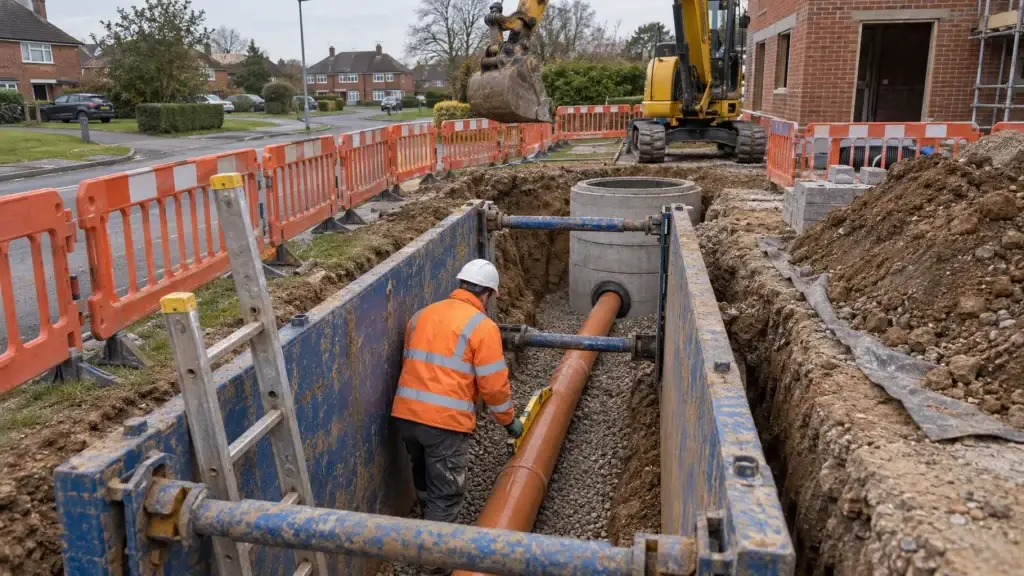
- The groundworks contractor builds the drainage to the approved design, makes the connection safely and keeps the trench open and safe for inspection.
Drains serving a single property within its own boundary are the owner’s responsibility. Government guidance on the 2011 transfer of private sewers defines a sewer as “a drain which is shared or used by more than one property”, which is why a pipe crossing your garden can still be public. Our guide to build over agreements covers what happens when an extension sits near one.
Common Mistakes That Delay Connections
- Applying late. Drains laid and the trench open before approval is in place.
- Assuming rainwater can go in the foul sewer. On Southern Water’s network it can’t.
- No percolation test. Needed to justify any surface water connection.
- Guessing the sewer’s position. A CCTV survey is cheaper than a redesign mid-dig.
- Changing contractor without telling the water company. Southern Water says that means a new application.
- Forgetting the highway licence. Often the longest lead time on a road connection.
- Backfilling before inspection. The trench may have to be reopened.
Where Dorrington Groundworks Fits In
We regularly make connections to public foul and surface water sewers for homeowners, builders and developers. That includes the excavation, pipe laying, manholes and the connection itself, working to the approved drainage layout and the water company’s standards. We can arrange CCTV surveys and percolation testing, and we coordinate with the water company for its inspection and sign-off.
We don’t replace your drainage designer, Building Control, the water company or the highway authority, and the application itself is normally made in the owner’s or developer’s name. We can help you get the sequence right so the trench is open when it needs to be and not before.
If you have a connection coming up, get in touch or call 01489 539197 to talk through the site.
Useful Official Guidance
- Southern Water: sewer connection (Section 106)
- Southern Water: wastewater connections technical guidance (PDF)
- Southern Water: new connections charging arrangements 2026/27 (PDF)
- Water Industry Act 1991, section 106
- Approved Document H: drainage and waste disposal
- Environment Agency: general binding rules for small sewage discharges to the ground
Frequently Asked Questions
What is a Section 106 sewer connection?
It is the process for getting a sewerage company’s approval to connect private drains to the public sewer, under section 106 of the Water Industry Act 1991. You have a right to connect, but must give notice first, and the company can refuse within 21 days if the construction doesn’t meet its standards or would harm its network.
Do I need permission to connect to the main sewer?
Yes, for a new property, an extension with a new kitchen or bathroom, a change of use, splitting a property, replacing a septic tank or adding surface water. Southern Water says you don’t need to apply if you are connecting to your own private sewer with no additional flow and no extra units, though Building Control still applies.
How much does a Southern Water sewer connection cost?
For 2026/27 the application fee is £299 plus VAT per connection to an existing sewer or manhole, or £369 plus VAT where a new manhole is built. New homes also pay a wastewater infrastructure charge of £771, or £671 where surface water goes to a soakaway or watercourse and the credit is claimed at application. None of this covers the excavation and drainage work itself.
Can I connect to the sewer myself?
Under Section 106 the applicant’s own contractor builds the drain and makes the connection, and Southern Water does not offer that service. It must be approved first, built to the water company’s standards, and inspected before backfilling. In rare cases the company can give notice that it will make the connection itself.
How long does a sewer connection approval take?
By law the sewerage company can refuse within 21 days of receiving notice, and Approved Document H advises notifying the company at least three weeks before you intend to connect. The company may also ask for changes to your plans before approving. Planning permission, surface water evidence and any highway licence can take considerably longer, so start early.
Can surface water go into the foul sewer?
Not on Southern Water’s network. It no longer accepts surface water into foul-only sewers, allows combined sewer connections only in exceptional circumstances, and requires evidence that soakaways, watercourses and other options have been ruled out.
What happens if a connection is made without approval?
It is an offence under section 109 of the Water Industry Act 1991, punishable by a fine of up to level 4 on the standard scale. The sewerage company can also close the connection and recover its costs.
Does Dorrington Groundworks carry out sewer connections in Hampshire?
Yes. Dorrington Groundworks carries out connections to public foul and surface water sewers across Hampshire, West Sussex and Wiltshire, including excavation, pipe laying and manholes, and coordinates the water company’s inspection. The application is normally made in the owner’s or developer’s name.